

Medieval Stoves
My goal in this project is to explore the history and evolution of the medieval stove. In particular, how to use them to cook recipes that are period specific for brewing and by extension, cooking. I wanted to know how different methods of using fire could affect the process of boiling liquids in order to make mead, beer, hippocras and other brewing related recipes. This quickly led to a wider investigation of kitchen set ups and uses throughout the medieval period for all cooking, not just brewing. I am not alone in this project of creating a medieval kitchen for use and experimentation with, Bannock the Baker (Benjamin Baxter) built a cobb oven onsite with help from Ulf of Malbu (Doug Arntzen). Next, after consultation with them on placement of the stove unit, we built a wooden post and beam awning structure to protect the units and workers from the elements as it is an outdoor set up. Once this was done, I was prepared to build my portion of the project which is the stove.
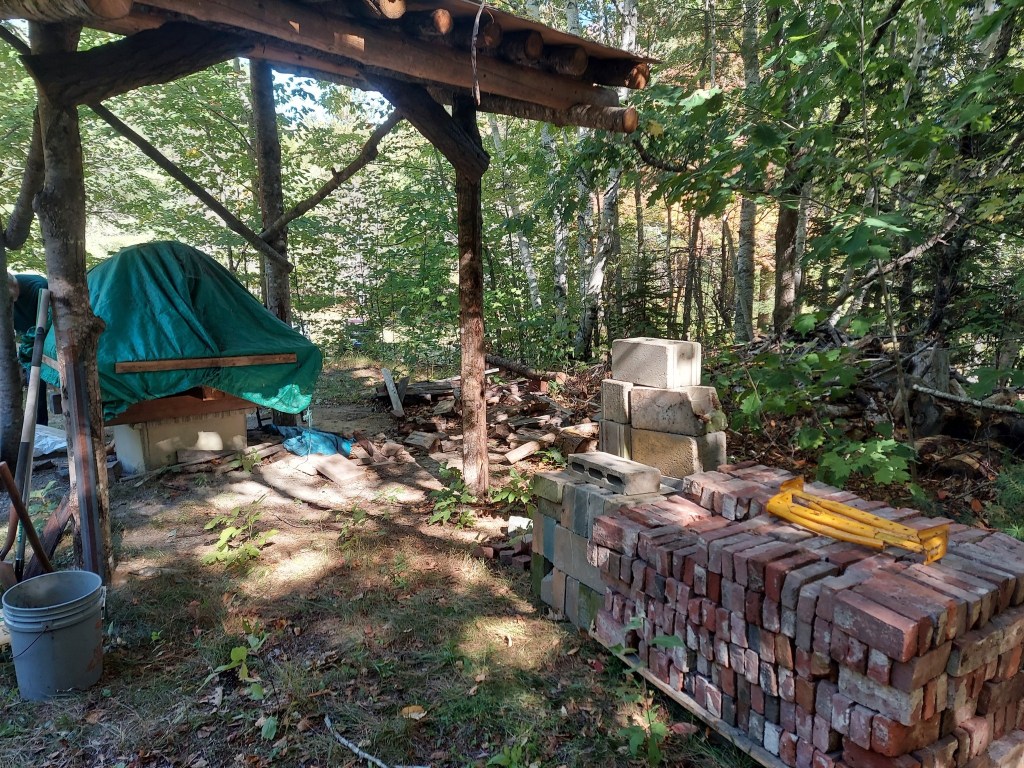
Materials
- Reclaimed bricks
- Type N mortar
- 2” flat bar steel
- Metal sheet
- Metal grate
- Reclaimed cinder block
Tools – I used all hand tools to build the stove.
- Hoe
- Shovel
- Mud tray
- Trowel
- Level
- Wood stakes
- String
- Hammer
- Chisel
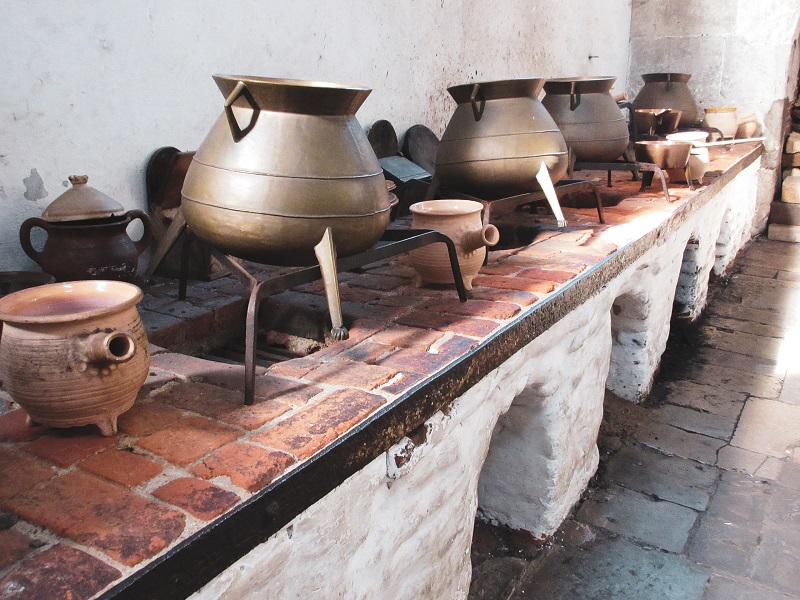
Sources – Hampton Court was my initial inspiration for this project with its functional soup stoves along one wall of the kitchen. There are a few photographs on the website that I was able to use as study material. https://www.hrp.org.uk/hampton-court-palace/whats-on/henry-viiis-kitchens/ For an in-depth look I found this great blog, https://www.nakedkitchens.com/blog/henry-viiis-55-room-kitchen-at-hampton-court-palace. I found several wood carvings and illuminations that showed raised hearths and soup stoves actively being used. One example being Medieval Cooking – A cook at the stove with his trademark ladle; woodcut illustration from Kuchenmaistrey, the first printed cookbook in German, woodcut, 1485 along with a great photo of a raised hearth kitchen from Kyburg Castle in Switzerland as reference. The Hohenlohe Open-Air Museum in Wackershofen of Germany has raised hearth kitchens. Another woodcut from Margarita philosophica (The Pearl of Philosophy) by Gregor Reisch. (Basel, 1508). The complete documentation and source images can be found here.
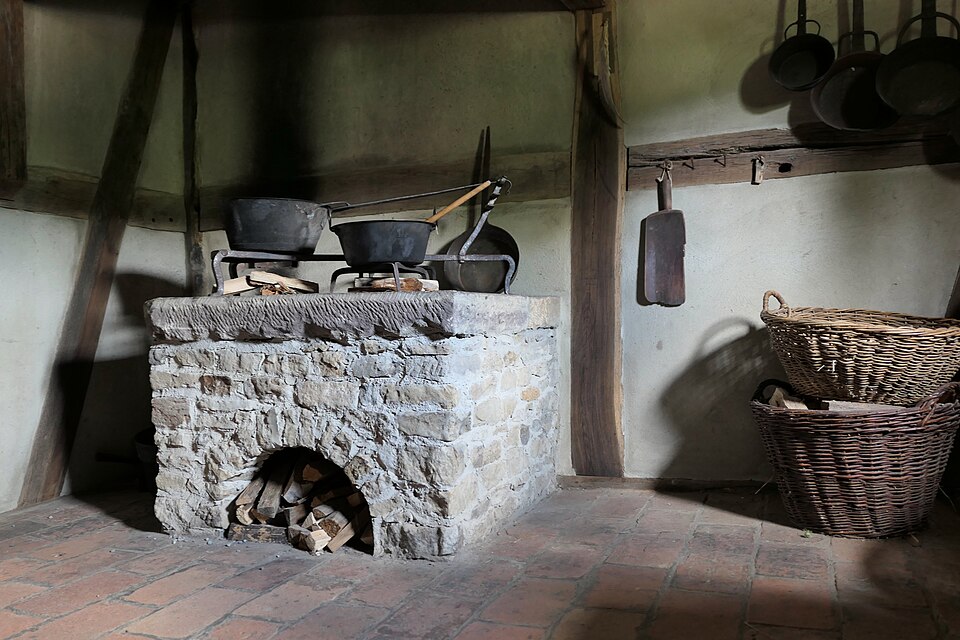
Haus Veit aus Zaisenhausen 16th century kitchen
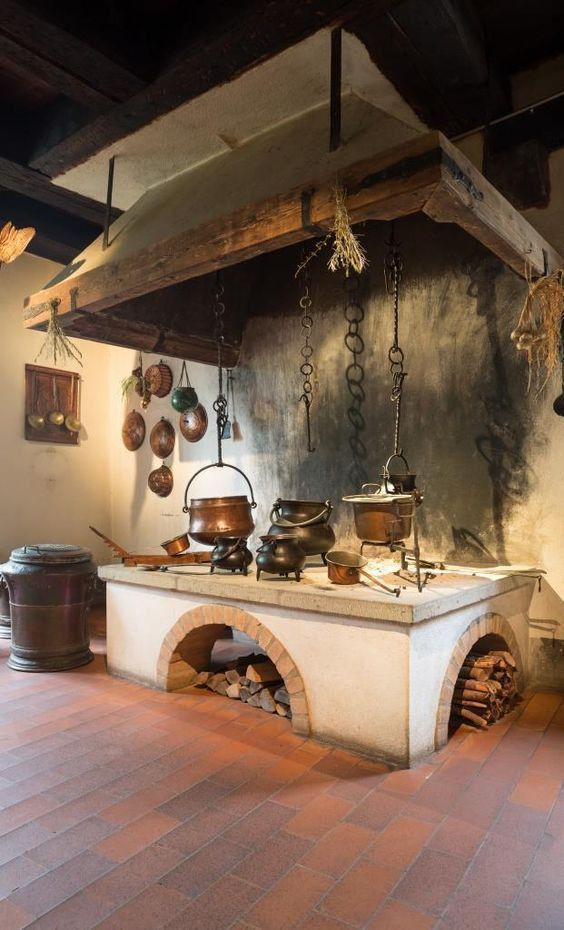
Process – Looking at the various photos and illustrations I made some educated guesses based on number of bricks and body proportions that the average height of the stoves was between 26” to 30” and the depth of the stove was about the same front to back. The distance between cooking spots seemed to vary wildly according to space available. I wanted to be able to cook on a raised hearth for early period cooking while also having the ability to use a soup stove for later period. Therefore, I decided to make a single unit that would incorporate both options by dividing the stove in half. I laid out a foundation of cinderblock roughly 32” by 6’ to simulate the floor of the room as a solid base and drove rebar into the ground in the four corners to help keep it from shifting. When setting the blocks I used stakes and strings to make sure the foundation was as level as I could get it before building the brickwork. In true period fashion I used reclaimed cinderblock and brick for this project to save money. As I laid out the courses a dividing wall was built between the two sides so that the wood could be safely stored under the raised hearth as the evidence shows that method in use. Because the focus of this was to explore how the stove functions, I did not emphasize construction techniques of period but rather on function. Rather than making arched openings I used flat steel to span the firebox and storage openings. When I got to the top, I laid steel across the opening to catch the brick joints for support. Using steel or iron is evident in the photos from the Hampton Court kitchen (Appendix A) but it is unclear if that was for structure or only used to span the openings of the countertop. I did not have enough steel, and I was out of funds but onsite an old piece of sheet metal and grill was found so I incorporated that into the soup stove side for holding up the top. As I prepared to lay the top, I reviewed my research images and found that the soup stove openings at Hampton Court were not centered on the firebox openings, they were in fact between the openings. Wood cuts showed people standing behind the unit to cook and then I realized that the size of the arch columns and position of the holes was to protect the cook from getting burned on a unit where you couldn’t stand behind it. I set the top hole slightly to the back to make it easier to reach from that direction to correct this problem. Two courses width according to the pictures.
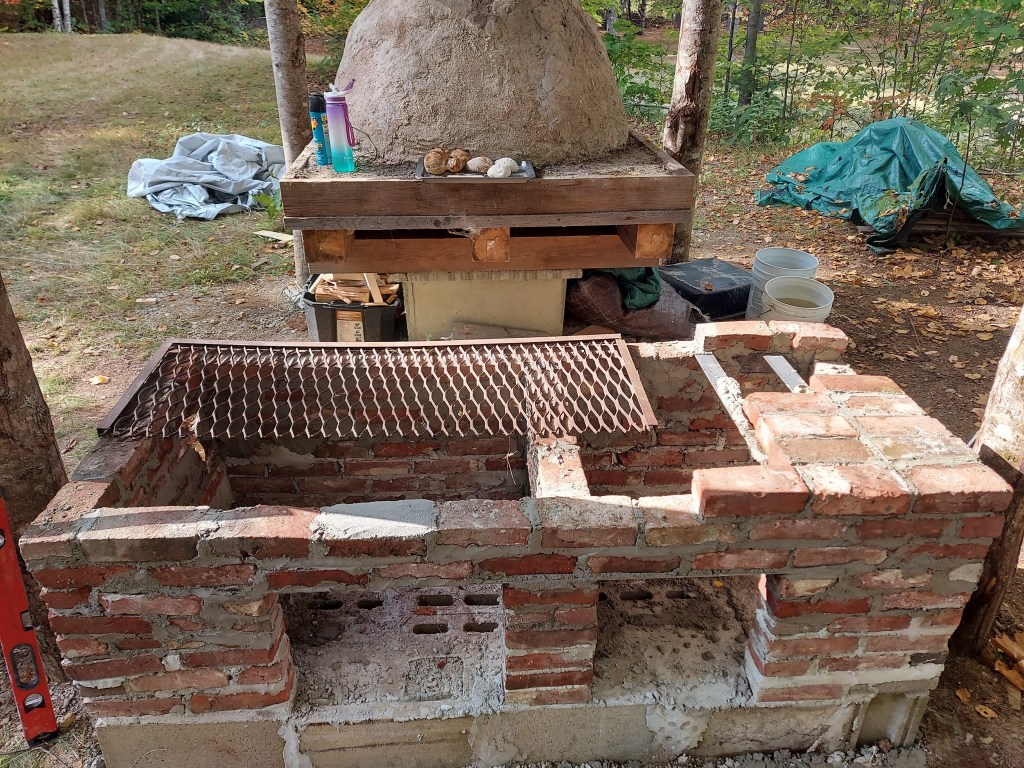
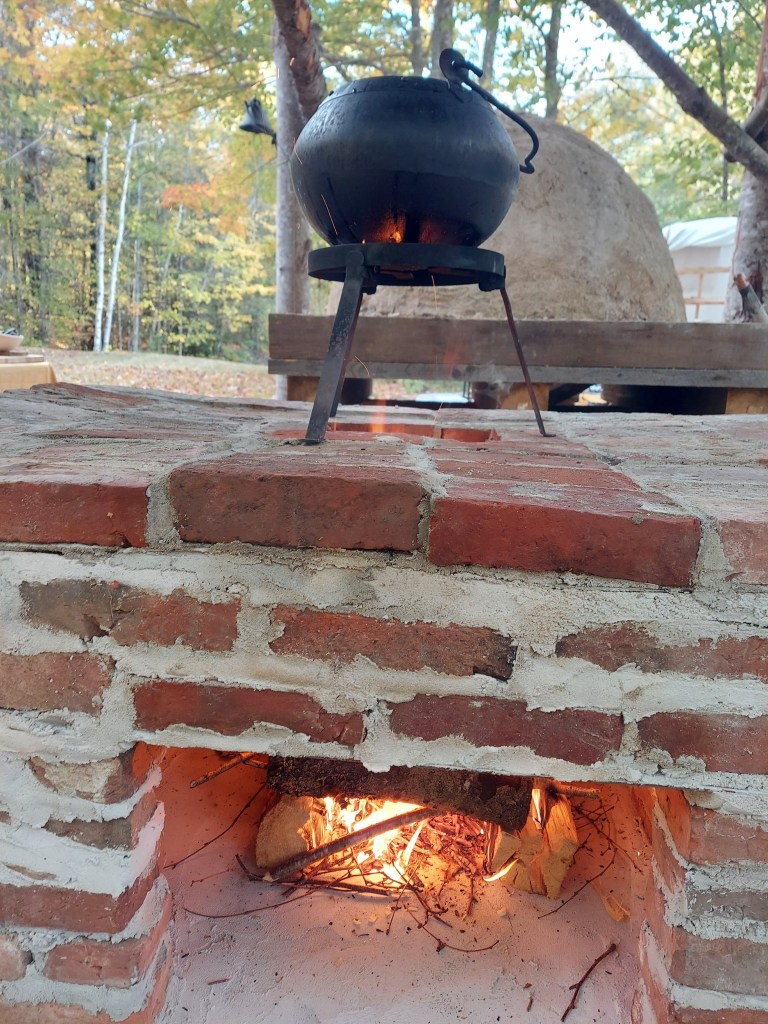
Implementation– To test the idea that the soup stove had much finer control over heat I chose two brewing recipes that did not require you to bring liquid to a boil but rather to heat it up till you can’t bear to keep your hand in such as a good simmer. One was a mead recipe based loosely off a German hopped and sage brew (Appendix B). I used 1 gallon spring water, 3lbs honey, 1 Quart dried hops and a handful of fresh Sage sprigs. The honey is modernly pasteurized so there was no need to bring it to a boil. Using my trivet over the hole as seen at Hampton Court I put the iron pot with water and honey on to heat. After 30 minutes the mixture was steaming, and bubbles slowly rose form the bottom. I added the sack with the hops and sage and then let it simmer for 45 minutes. The mead never got to a boil and stayed just hot enough that I couldn’t leave my hand in it so that was a successful test. The second recipe was a hippocras from The Goodman of Paris (Appendix B) where the spices had been made before to create the Dukes Powder and all I needed to do was heat the wine (Pinot Noir) to dissolve the sugar and spices into. I used a clay pot this time on the trivet and got the same results as before. It took 30 minutes to simmer and then only 5 minutes for the sugar to dissolve at which time I removed the sack of spices and let it cool before serving. I have made this recipe before and the only difference in taste was that the spices were slightly stronger in presence than the previous method I used of straining it through boiling wine several times. In order to make a stew later that day which needed to boil the only thing that had to be done by the cook was to lower their pot on thin stones rather than use the trivet. A resounding success in exploring the ability to control the heat using the soup stove. Using the raised hearth side is very straightforward and you only need to have a SMALL fire under the trivet to cook on.
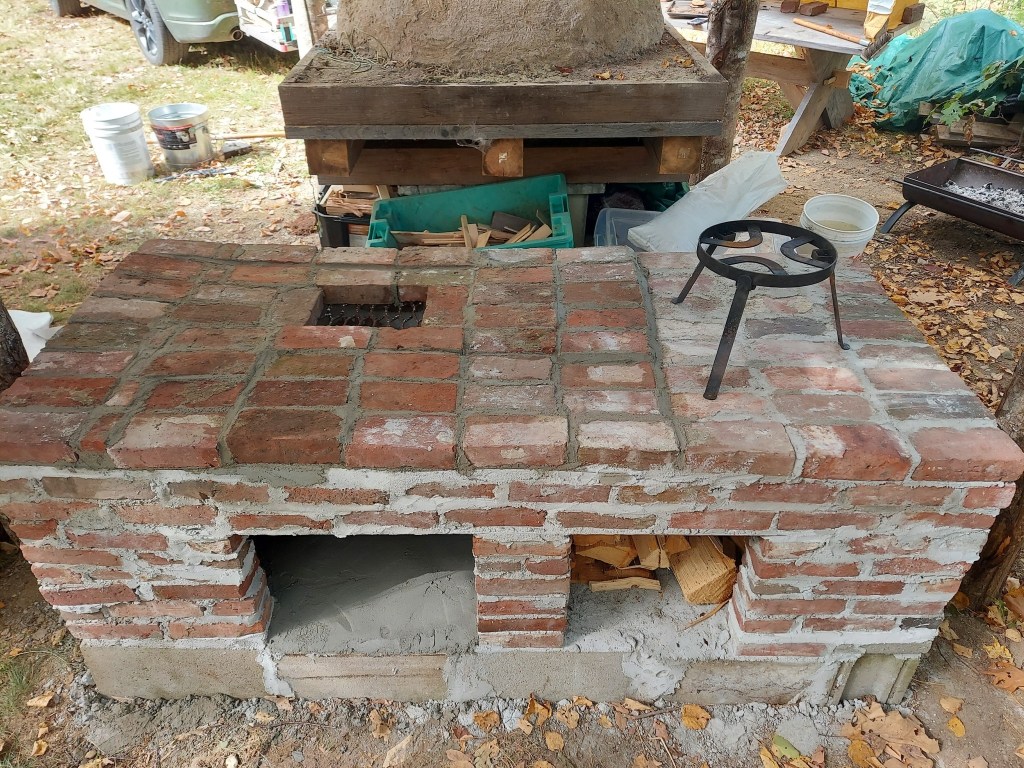
The Future – This stove was built on a site continuously used for medieval events with the goal of other people being free to use and experiment with it. To that end I am getting three different trivets of the varying heights 2”, 4” and 6”. This will allow the cook to control how hot the cooking surface will be and free up the original trivet for use on the side with the raised hearth where the fire is used directly under it.
As part of the larger outdoor medieval kitchen our next step is focusing on preparation areas such as worktables under canvas awnings and iron hooks for lanterns. This will help with nighttime operations and inclement weather.
 The Misadventures and Projects of Thomas de Marr'