
Medieval Hunting Horn
A Master work project for the East Kingdom Forester Guild
History & Calls of the Hunting Horn
My goal in this project is to explore the history and evolution of the medieval hunting horn and its calls. To recreate the horn calls of the past is a difficult challenge in and of itself but taking what I learn to write horn calls for the Forester Guild of the SCA is the final goal. This project was broken down into three video classes to be shared with the populace in digestible packets of knowledge.
How to blow your own horn (Part 1)
- Mechanics of how to make sound from your horn.
- Brief overview of types of horns
History & calls of the hunting horn (part 2)
- Natural horns.
- Mouth pieces and metal horns.
- 1633 was the first use in musical composition known in the opera Ermina sul Giordano.
- Windes are phrases.
- Notation – horn tablature.
- Phonics.
- Types of calls used.
Forester horn calls (Part 3)
- Swainmoot
- Return
- Begin
- Help / distress
- Contact / found it
- Water
- Danger
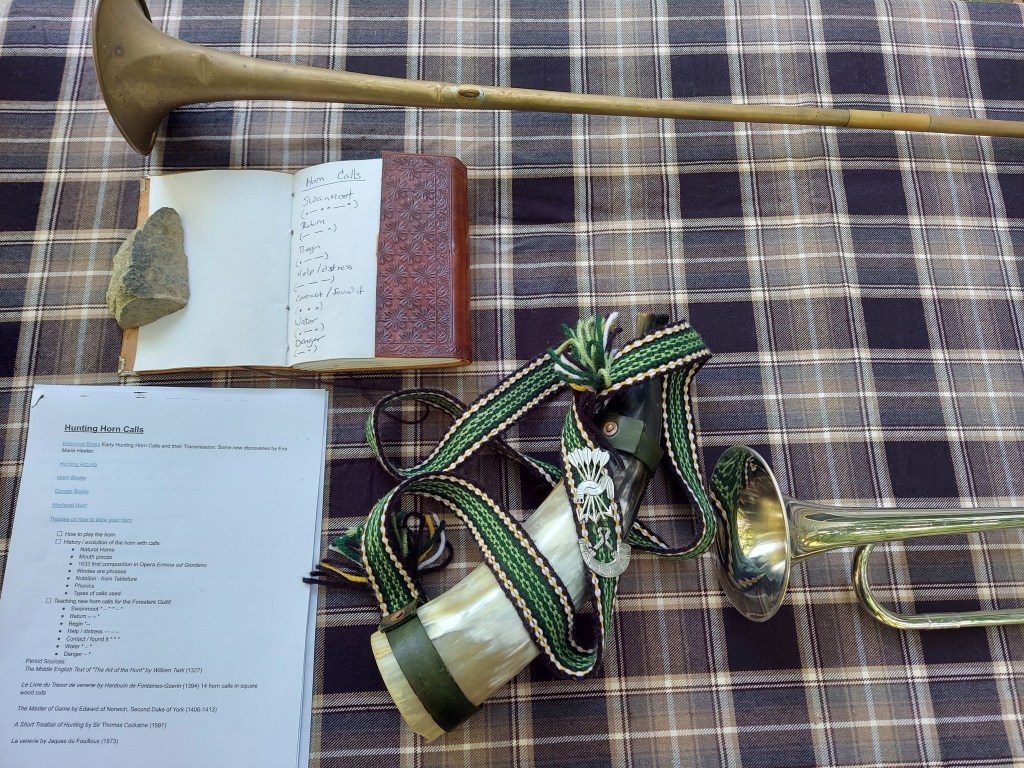
Tools – Demonstrating these lessons I used a period style cow horn that I strapped and belted myself. I have a heraldic straight trumpet and a folded trumpet, or bugle as it’s known today. The rams horn shofar was a great addition to the lesson.
Sources – I found multiple translation excerpts from the following sources. As I don’t read French and Middle English I had to rely on these translations of the original sources.
The Middle English Text of “The Art of the Hunt” by William Twiti (1327)
Le Livre du Tresor de venerie by Hardouin de Fontaines-Guerin(1394)
The Master of Game by Edward of Norwich, Second Duke of York (1406-1413)
A Short Treatise of Hunting by Sir Thomas Cockaine (1591)
La venerie by Jaques du Fouilloux (1573)
Noble Art of Venerie or Hunting by George Gascoigne (1575)
There were two modern publications I found that helped me find and verify original sources, and provided information I was able to verify through cross referencing which are as follows:
Early Hunting Horn Calls and Their Transmission: Some New Discoveries by Eva Marie Heater from the Historical Brass Society.
‘How the hunter shal blow’: An Unpublished Middle-English Treatise on Horn-Blowing by David Scott-Macnab in Medium Aevum – December 2021.
Process – After much searching and reading I found that my goal of recreating a period horn call was not possible at this time. There are numerous ways that horn calls were passed down however there is the problem of assumed knowledge. I am referring to the fact that what we are missing is the primer or “Rosetta Stone” of reading these various writing systems which have come to be known as “Horn Tablatures”. These are ways of recording horn calls through icons or symbols that pertain to recording in a written fashion, horn calls, not necessarily musical notation, although one example given does resemble what we now know as standardized musical notation. I came across four different variations of recording horn calls, three as a horn tablature and one as phonetic descriptions. The phonetic descriptions bring us the closest to recreating a period horn call but there are still many ways to interpret the same written description.

Here is a woodcut horn tablature as shown in Le Livre du Tresor de venerie. These are black and white squares showing groupings but no known code to understand it. Is the black a short note and the white a long note or vice versa?

This tablature comes from Noble Art of Venerie or Hunting. Similar to cursive writing in the flow of the pen it uses circles with arches and dots overtop plus what looks like brackets and slash marks. We do know that the slash is a rest because the manuscript has writing below one such notation stating this mark means to rest. It is the ONLY definitive knowledge of markings at this time.

Here we see the closest tablature to modern understanding. While it’s tempting to say we can read and play this, it’s not entirely true. This represents a series of notes in a line and only one note being long while all other notes are short without any change of rhythm. However, the difference in the number of eigth note banded together indicates groups which would naturally need pauses in between to give the call changes in rhythm.
William Twiti also gives us phonetic descriptions using “trout” and “trourourourout”. These could indicate length of notes or it could mean to quaver the note while playing it a determined number of times. Still the phonetics come the closest to describing what a period call would actually sound like.
All the manuscripts describe horn calls as a collection of short and long blast of the horn with no concern or mention of changing pitches while playing. Later period sources do speak of the difficulty for even good horn blowers to effect pitch changes and then only on horns with metal mouthpieces or completely metal. As a trumpet player myself I can personally attest to this challenge while using my various horns. The positive side to this is that we know as a result medieval horn calls are old version of morse code, a series of short and long blasts with spaces between. This makes the project of creating Forester horn calls today easily taught and understood. Two more terms known to describe period horn calls are “Windes” and “Strake”. The windes seem to refer to groups of notes within the horn call like phrases that may be repeated in a single call or put into other calls in a different order. This indicates a sophisticated horn call language with rules in how calls are structured and used. The Strake refers to the horn call in it’s entirety.
The types of calls varied in their purposes and got more intricate as the culture of hunting grew more widespread and sophisticated. There were calls used for the hounds to tell them what to do and by necessity those calls were of a simpler nature. The same as training dogs to whistle commands today. Many of the calls were for the people managing and working the hunt to communicate direction of the prey, what type of prey and even the “Prise” meaning the hunt is successfully completed, the animal is down.
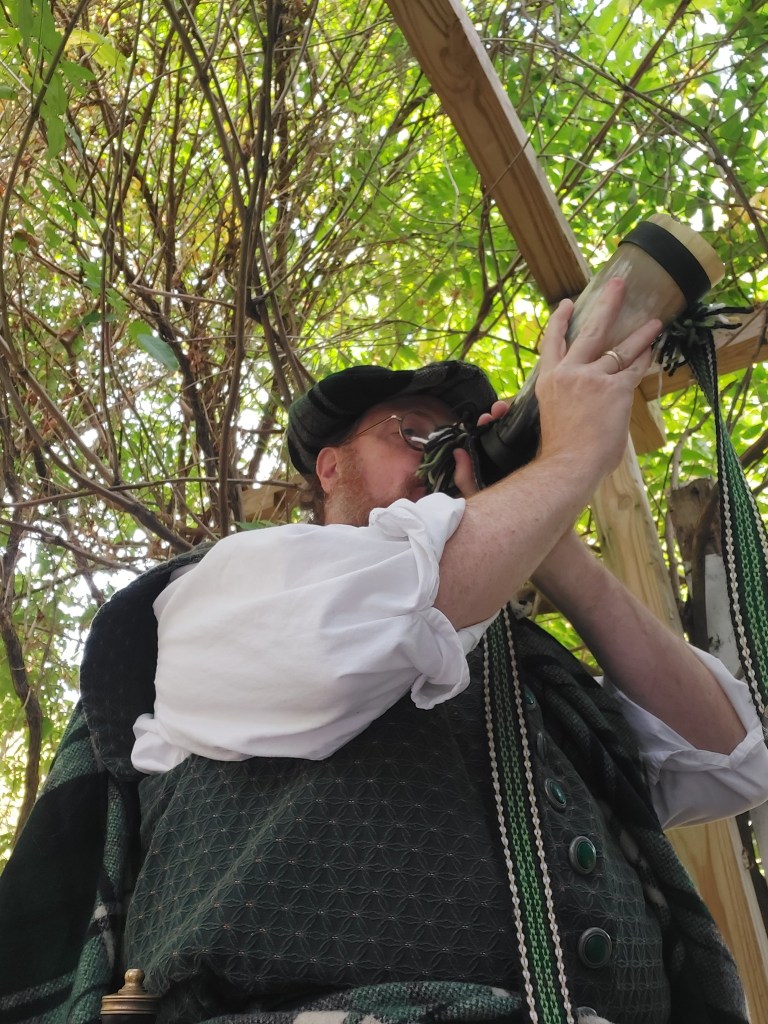
Forester Horn Calls – To develop horn calls for the Forester Guild I needed to determine what types of calls were needed or useful to have in the field. Guild activities center around hiking, camping, canoeing and land management so these are the activities I looked at for potential communication needs. A Swainmoot is the gathering or court of the Foresters Guild which needs a call to order or call to meeting. Return is a signal to return to camp or meeting place. This will help bring in or recall Foresters who may be out in the field looking for something or working on a task. Begin is the opposite and can mean anything from start walking after a break or start a challenge. Help or distress is the most important call we need to use. Human nature seems to always be to blow three long notes when calling for help, so I decided to use that instead of fight it. When adrenaline is high we act on instinct and this will play into that tendency. Contact or found it covers anything from found what was being searched for, or contact made with creature, person or item of interest. Water is just as important. Finding a source of drinking water is always critical when in nature but also refers to landmarks used for navigation like rivers, streams or ponds. Last but not least is the signal for danger. It’s a heads up, pay attention, somethings not right, we need to pay attention. The call covers situations like fire, inclement weather, landslides, floods, dangerous animals or even people.
To keep things simple and easy to learn I approached these calls with the plan to write it out as morse code as a SCA Horn Tablature, you do not need to be a musician to understand or read the horn calls this way. What I have written out is the first windes of the call. Each winde will be repeated three times to make the Strake or complete call. Many times, we miss hearing the first part of a conversation (or horn call in this case) so repeating a simple winde three times allows time to recognize there is a call being played, identify the call message and finally use echo location to determine the direction or location of the horn player. This is especially important when calling for help or announcing danger.
Forester Horn Tablature –
Each winde written gets repeated three times to make a strake.
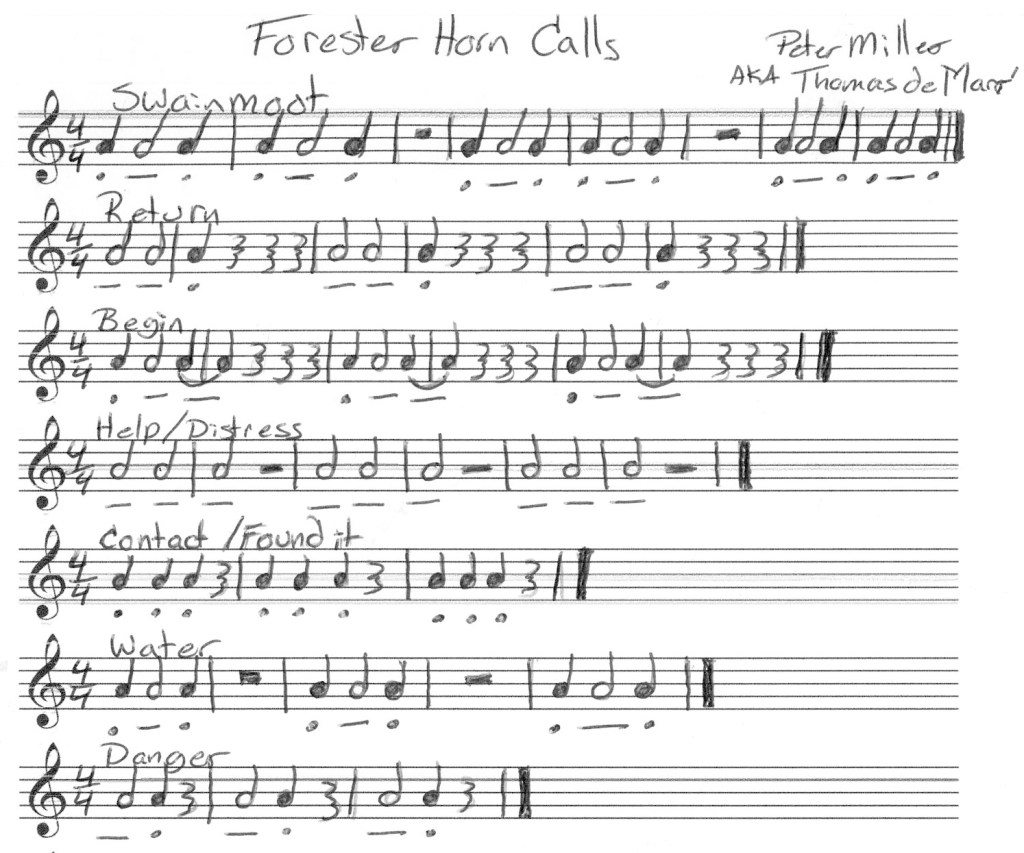
- Swainmoot * – * * – *
- Return – – *
- Begin *_ _
- Help / distress — – –
- Contact / found it * * *
- Water * – *
- Danger – *
Appendix
The following is the standard musical notation of the horn calls with the horn tablature written underneath the staff where lyrics would be printed. This creates a primer or Rosetta stone for the modern tablature I created based off of morse code.
A PDF copy of this documentation can be found here.
Download a copy of the sheet music here.
 The Misadventures and Projects of Thomas de Marr'